Three Leadership Lessons from Climbing The Three Peaks
The best leadership lessons don’t always come from the boardroom. This year, mine came from three mountains and a nine-year-old.
As he touched the summit cairn, he’d done it! My nine-year-old son, Arthur, had completed all three. The highest peaks of Scotland, England and Wales.
It started on Ben Nevis at Easter, just the two of us. This summer we added Scafell Pike with his cousins, then finished on Snowdon, all 3,560 feet of it.
It was fitting that Snowdon, or Yr Wyddfa in Welsh, was the last. The legend of Snowdon is that King Arthur slew the mythical giant Rhita Gawr (“HREE-ta GOW-r”). Rhita apparently had a thing for chopping off kings’ beards to weave into his cloak, but King Arthur wanted to keep his and killed old Rhita for such temerity. He and his men buried Rhita Gawr under stones that became Snowdon.
Myths aside, I’ll share three thoughts on our three peaks.
1. Path > Elevation
Let’s talk about the lowest one, Scafell Pike at 3,209 feet. It was actually the toughest. Scafell has the longest sections without a proper path, strewn with loose scree. So, whilst being a relative stubby compared to its English and Scottish siblings, it was easily the hardest.
It had me reflect on how easily we compare our achievements with others in life without considering the difficulty of the path. Maybe others have risen higher on the totem of success, but perhaps their route was softer. Personal ownership still matters. But if you do submit to the folly of comparing yourself with others, remember the smoothness of your respective paths may have been very different.
As FirstHuman Partner, Gary Borland, likes to say in reminding us not to elevate those around us,
There are no giants.
2. The Power of Belief
The second lesson was a reminder of the power of believing in what’s possible. Two-thirds of the way up Ben Nevis, we found ourselves in a group of six. Arthur, myself and four other men. The visibility had reduced to around 30 metres, and it was lightly snowing. As we shuffled up this last third, we started to pass a few people coming the other way who had decided to not continue to the summit. Seeing this, the four other men with us soon decided to turn back also.

Arthur Atherton ascending Ben Nevis, Easter 2026.
I wanted to keep going. The navigation app on my phone was working well. There were plenty of way-marker cairns to show us we were on the right track. Visibility was low, but we were still a way from white-out conditions. It was cold, but we were in the right gear. However, Arthur was getting nervous, and I didn’t want to force him.
As I was starting to think this might not be our day to summit, great fortune struck in the form of three teenage lads ambling down from the top, the first peak down in their own Three Peaks Challenge.
As they approached, I asked them if they’d been to the top. “Yeah” was the nonchalant reply. Then one of the lads, seeing that Arthur was nervous, added that there were “loads of kids” on the top.
Of course it was a lie, but Arthur didn’t know that. As far as he was concerned, there were other kids up there and he was going to get up there too. This instantly transformed what he believed was possible and immediately changed his attitude.
The four men turned back because others had. Arthur kept going because he thought others had made it.
Arthur and I marched on, passing perhaps another twenty people who’d decided to turn back before summiting. And we made it!
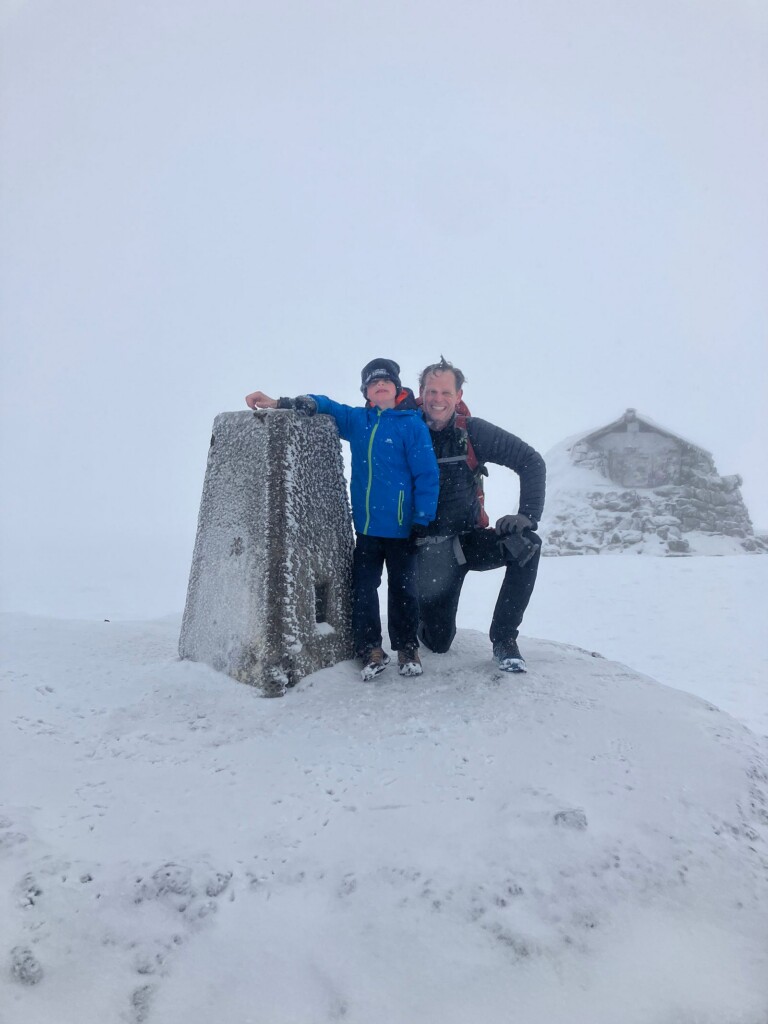
Richard and Arthur Atherton on summit of Ben Nevis, Easter 2026.
On the way back down, after reaching the peak, it seemed like Arthur had grown another foot tall as people spontaneously congratulated him on discovering we’d made it. “How old are you, kid?” they’d ask. “Great work.”
The power of belief indeed.
3. Who Needs Shoes?
The third is a shameless plug for the benefits of my new favourite pastime, earthing. Earthing is getting your feet on the earth, or at least making an electrical connection between it and your body.
I climbed almost all of Scafell barefoot, and the advantages were palpable: more energy, fewer layers needed, and a greater sense of ease of movement. Not quite mountain goat, but you get the idea. With improved heat regulation, I summited in shorts and a T-shirt. Our bodies are much more capable, and often need far less than we think.
Researchers on earthing claim reduced inflammation, improved sleep quality, lower stress, better mood, better blood flow, and more.
If you’re interested in more, check out episode 19 of my Being Human podcast with John Craig.
Furthermore, being earthed gave me a special feeling on the mountain. I would say, being ‘at one’ with the mountain, but that might make me sound like a hippie.
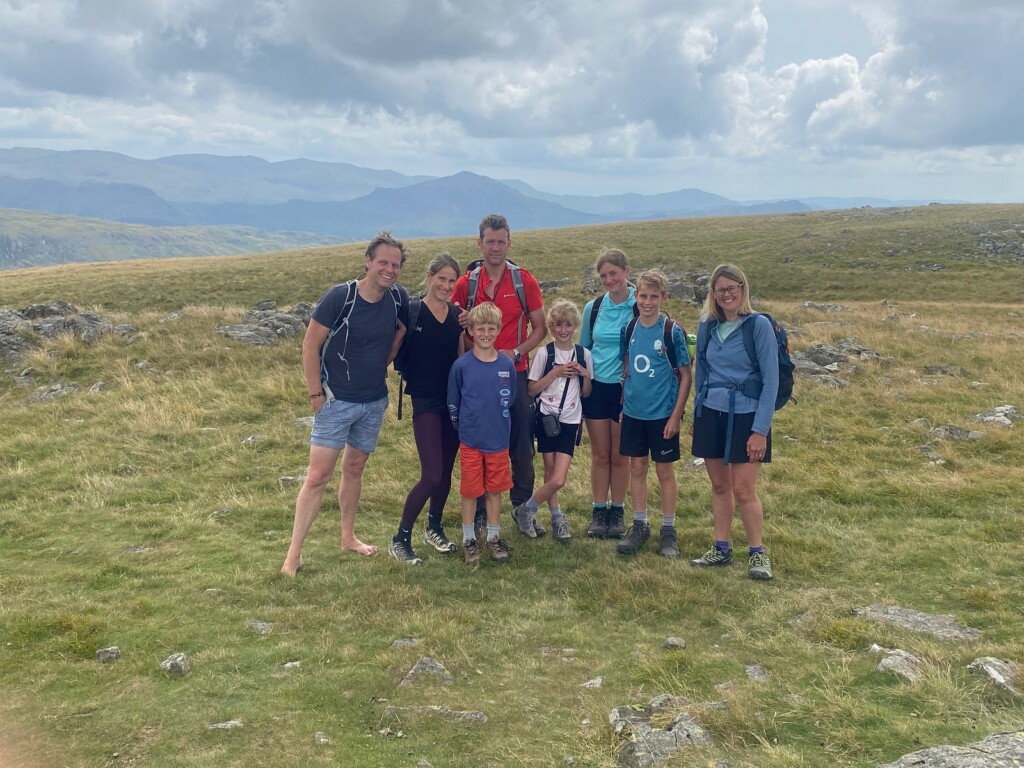
Atherton and Dawson families, Lake District National Park, summer 2026.