
5 Takeaways for Leaders from Conversations with AI Pioneers
Consumer LLMs are penetrating at the individual employee level; better leadership and change management are required to crack the enterprise
Late last year, I had a series of conversations with, actually, two pioneers in the AI space: Daniel Hulme and Dr Alastair Moore. Both were co-founders of Satalia, one of the UK’s most successful AI businesses.
They sold Satalaya to WPP in 2021. Daniel now serves as the Chief AI Officer at WPP, and Dr Alastair Moore has gone on to found another AI start-up, DeepFlow.
Here are five actionable takeaways for leaders that I gleaned from the conversations.
Experiment to differentiate
Now more than ever, leaders need a bias toward experimentation, especially in areas that differentiate their business’s core value-creation. They should avoid commodity use cases, like expense bots, which vendors will soon bundle.
Alastair also points out that, because AI technology is evolving so quickly, the same experiment that fails today may succeed in just a few months’ time. Leaders need to be prepared to continually re-evaluate the results of past experiments as technological developments unfold.
Understand whether you truly have an AI advantage
A competitive edge in AI comes from either unique data or speed to market. If you have neither, building in-house AI for its own sake is likely to fail.
Be realistic about AI talent and operating capability
Deep AI talent is scarce. Leaders must assess if they can realistically attract, manage, and retain an in-house team. If not, use vendors for commodity agents instead of building expensive custom solutions that become liabilities.
Shift from hierarchy to orchestration
AI exposes the limits of traditional hierarchies. The leadership task becomes allocating work more fluidly across humans and machines, designing adaptive systems rather than managing people through rigid structures. As with all efforts to shift a business culture towards greater self-management, this means a reorientation and a degree of letting go from senior leaders.
Invest in leadership judgement, not just technology
The biggest risk is poor decision-making at the top: chasing hype, placing the wrong bets, or misunderstanding AI’s implications. Leaders who develop critical thinking, systems awareness, and ethical judgement will outperform those who simply “adopt AI.”
On a related note…
This write-up would not be complete without a mention of the 2025 report from MIT’s NANDA initiative — The GenAI Divide: State of AI in Business 2025.
The researchers analysed 150 executive interviews, 350 employee surveys, and about 300 real-world AI implementations. It found that nearly 40 per cent of organisations had deployed tools like ChatGPT and Copilot. Furthermore, even when companies aren’t buying LLM subscriptions, employees are still using them.
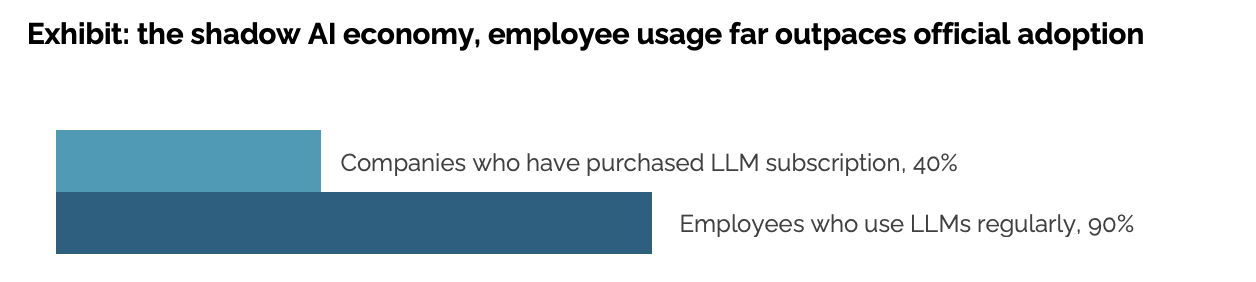
Source: MIT’s NANDA initiative — The GenAI Divide: State of AI in Business 2025
This “shadow AI” often delivers better ROI than formal initiatives.
When it comes to enterprise generative AI however, the study reported that only about 5% of pilots delivered measurable business impact or rapid revenue growth, with the vast majority stalling at the pilot stage or providing little to no profit-and-loss (P&L) benefit.
Two key reasons cited for the high failure rate underscore many of the points made by Daniel and Alastair:
- Lack of strategic clarity and effective change management, with many pilots driven by hype rather than solving specific business problems.
- Internal capability gaps — teams underestimate the operational, data, and organisational skills required to scale AI. In fact, internal builds fail twice as often.
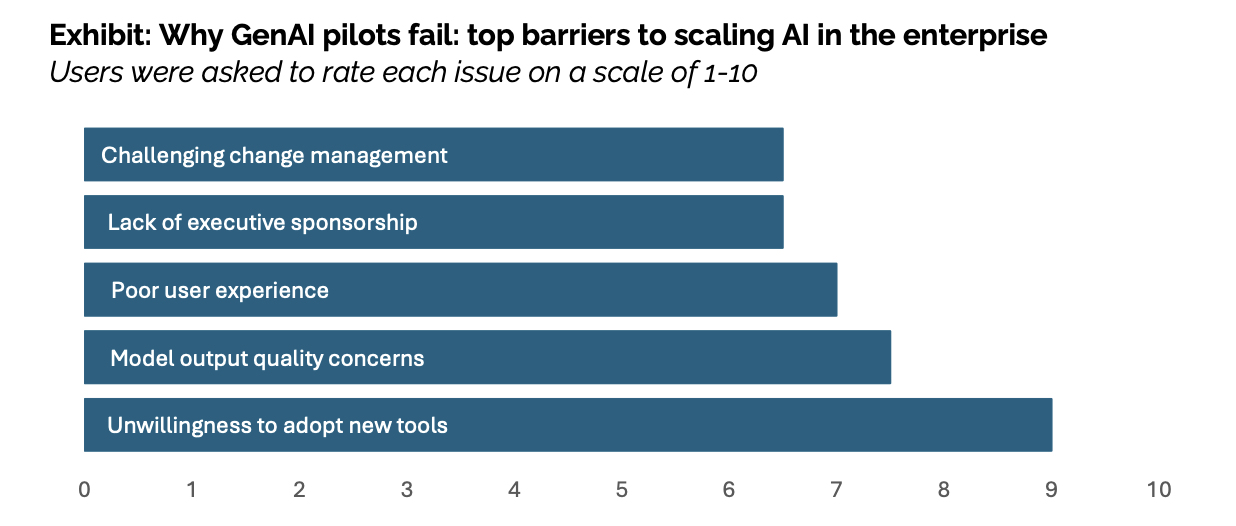
Source: MIT’s NANDA initiative — The GenAI Divide: State of AI in Business 2025
A further two are:
- Poor integration with existing workflows and systems, so tools don’t fit how work actually gets done.
- A failure of the models to learn from feedback and adapt to their context.
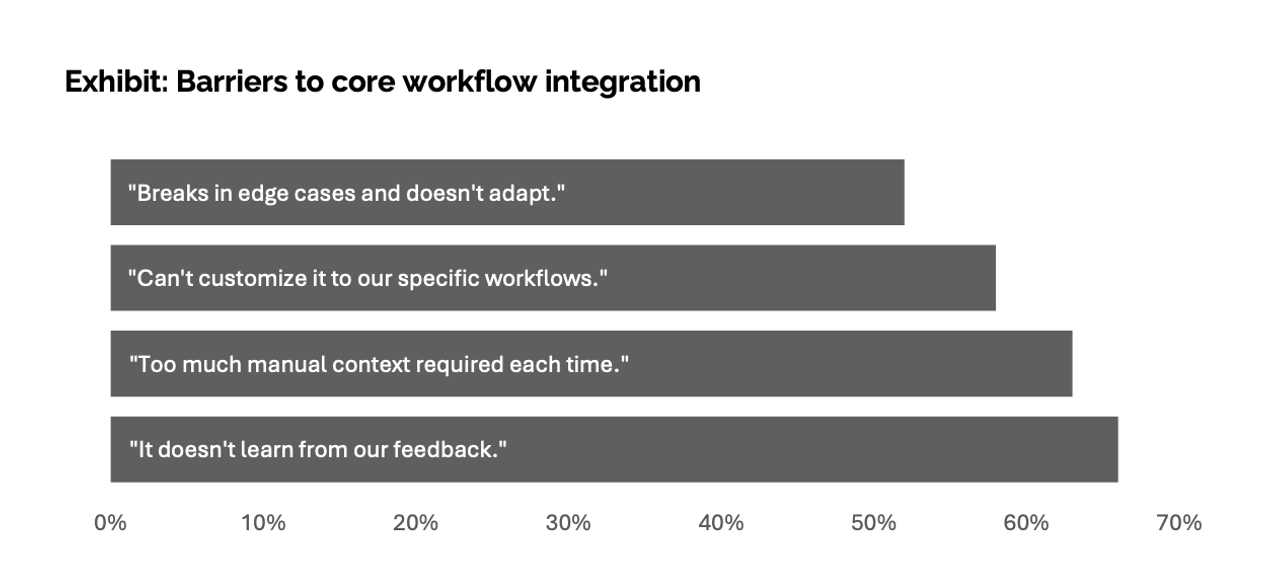
Source: MIT’s NANDA initiative — The GenAI Divide: State of AI in Business 2025
In summary, beyond deploying personal productivity tools, AI adoption is a whole-of-organisation endeavour:
- At the enterprise level, AI is definitely not a “plug-and-play” productivity booster. Success depends on thoughtful integration, clear business goals, cross-functional collaboration, and a culture of autonomy to harness system-wide benefits.
- Leaders should invest in change management, data readiness, and clear KPIs to maximise their chances of success.
- Organisations should balance internal ambition with external partnerships where appropriate, since vendor or specialist collaborations often have higher success rates.
- The ability for the models to learn based on context appears to be a weakness for Generative AI.
- Finally, the findings reinforce that leadership and organisational capability — not just model performance — are the real drivers of AI value creation.